Tuesday, December 2, 2008

Sandor Vegh “Hacktivists or Cyberterrorists? The Changing Media Discourse on Hacking” From First Monday 7 October 2002


The last reading for the semester, how time flies. This will be the second time I’ve been able to say it’ll be my last post, since I thought my last high school post would be the finale, but clearly I was wrong. Sandor Vegh’s dissertation entitled “Hacktivists or Cyberterrorists? The Changing Media Discourse on Hacking” deals with the medias portrayal of hacking and how it changes public opinion. Vegh talks about how hacking changed after September 11th, 2001, and how it is now looked at as almost cyberterroism. Hacktivism, which is online political activism, is considered dissenting against the government. He also goes on to explain cyber and informational war that has been on the rise since the capable technology has come into fruition.

When I read this article the first thing I thought of was the movie “Live Free or Die Hard,” in which cyber terrorists enact a “Firesale.” They hack into almost everything electronic, the stock market, power grids, TV lines, police radios, and send the American people into mass panic. If anyone has the capability to do what the characters did in that movie, we are certainly in trouble. Is cyber terrorism going to turn into the modern warfare? Are countries going to hold us hostage by hacking into our systems? It is possible, but I believe our government has the strongest minds and defense on our electronic systems that will limit something that great.

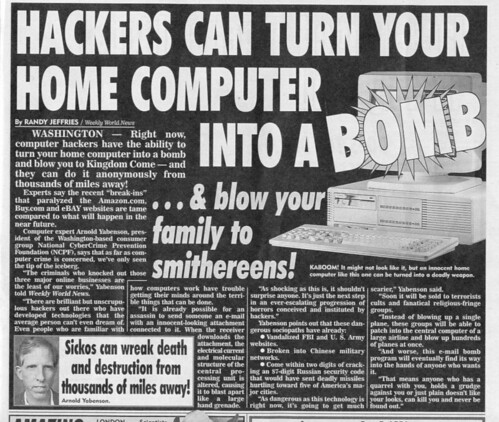
The other interesting thing presented in the article was the media’s effect on the American public. Hacking at one point was considered a good thing, but with the media portrayal they turned the word into something with a negative connotation. It was also interesting to read the different article excerpts explaining possible terrorists attacks. They were either extremely vague with little details provided by the sources or just looking to issues warnings by including places where a threat was possible. The whole idea of sensationalist reporting after 9/11 was probably done to sell more newspapers, but it also had an effect on the public by helping stir up fear within them. The media really does affect the public and its opinion. Its ability to do so should be considered in claiming terrorist reports or any type of article that might instill fear.

Friday, November 21, 2008

Don Sharp "Under the Hood" from Harpers Magazine June 1980


With the finishing of Don Sharp’s Under the Hood, we are official done with the $100 course pack. A very strange yet interesting two pages from what seemed like a grumpy old mechanic criticizing our society. The excerpt starts out by telling the reader that Don runs his own mechanic shop in which he fixes up cars real problems without scheming them out of money like a real auto shop would do. Sharp discusses some common car parts and how they work, as well as some common problems. He begins to talk about how mechanics really don’t understand what is going on under the hood and how they get paid in any event regardless if they fix your car or not.

Sharp speaks a lot about the “cause and effect” relationship and how both drivers and mechanics gave up worrying about this. Drivers assign responsibility for the car’s smooth running to someone else. They never believe that their actions were the ones that damaged the car. While the mechanic does not attend tot eh behavior of the car instead he consults charts and tries option B if A was unsuccessful. Sharp says two thirds of batteries, starters, alternators, ignition coils, carburetors, and water pumps that are sold are not needed. That if the mechanic knew enough about the car or decided to look deeper they would realize the true problem might only be cleaning battery terminals. He faults the people though saying if they decided to study the cause and effect of the events that took place under their hood they might be able to distinguish this problem and prevent spending all that money.

If people were more simulation literate they would be willing to accept responsibility for their machines it would added to the sense of individual worth and of the moral strength of the culture. Sharp says a person who looks into the cause and effect relationships shows a lot about their morals and character.

Tuesday, November 18, 2008

Lawrence Lessig Chapter 10 of Free Cluture (2004) Published by Penguin Press


The third and final Lawrence Lessig reading comes from his book Free Culture published in 2004. While CODE seemed to deal more with the regulation of cyberspace, Free Culture deals with the property owner’s battle versus new technologies. He concerns himself with the fact that certain powerful interests, such as Hollywood, are using copyright law to lock down the very stuff of creativity especially past creativity. We begin at chapter 10 and right away Lessig gets into what the framers of the Constitution wrote about property. How they wanted it protected and fair compensation given if it was taken, but they also said that progress is arts and sciences should be promoted. Copyright laws have ensured that authors have a property right in their work for a limited duration. Part of the reason for a limitation is that change has always drawn upon past culture to produce the new. Now that copyright is extended it has harmed the growth of new creation.

Lessig talks about the four different modes of regulation; they are law, norms, market, and architecture. Law is the act of being threatened or punished for violating a copyright rule and are usually imposed by the state. Norms are also punishments but imposed by the community. Market is a property law that defines what must be bought if it is taken legally. Lastly, architecture is a constraint on behavior usually through simultaneous conditions. All these constraints interact and help protect property.

Upon looking at the book, I couldn’t help notice the website that is featured on every page. The website leads to free downloads of the book in various formats as well as being able to hearing it read out loud. I thought this was very interesting; it’s the exact opposite way big business such as E-Book Reader acted with the Alice in Wonderland book. Lessig is obviously a very smart man and knows a ton on this subject; the problem is everyone is touched by copyright whether they know it or not. People need to get educated.

Thursday, November 13, 2008

Lawrence Lessig Chapter 4 of Code Version 2.0 (2006) Published by Basic Books


Part two of three from Lessig, this second reading is the next chapter in his book Code. He expands on his ideas that he brought up in the last reading. Chapter four is entitled Architectures of Control. Lessig spends much of his time talking about identity in the future, this is the who does what where aspect of cyberspace. He talks about how at first people were like the invisible man, no one was able to keep track of what people where doing. It is now in a more regulated state in which people can be tracked by three familiar ideas – identity, authentication, and credential. Identity consists of attributes of a person. Authentication is the evaluation of your identity, while credential is the device for authenticating. Lessig says that identity and authentication in cyberspace is getting better due to TCP/IP addresses as well as ISPs and cookies.

This chapter was much longer and more technologically intensive. The writing and content dealt a lot more with the actual details of computers and cyberspace. The ability to have people know who is surfing what where on the Internet greatly benefits us. It allows for websites to be customize based on geographical features and allow for a webpage to have a more personal feel to each user.

Lessig also talks about how the unregulability was a product of design and that the failure of the network to identify who someone was, and what they were doing meant it would be difficult to enforce rules upon them. Now with the newer technology bridging these gaps many commercial interests have come about, such as online purchasing. Of course new problems arise such as viruses, ID theft, and spam, but this only shows the world that there is still a lot of unregulable behavior out there.

Tuesday, November 11, 2008

Lawrence Lessig Chapter 3 of Code Version 2.0 (2006) Published by Basic Books


The all-important fallacy of the “is-ism” is an interesting subject; it is the mistake of confusing how something is with how it must be. Lawrence Lessig looks at this fallacy in depth in chapter 3 of his book CODE version 2.0. He puts to bed the rumor that the Internet cannot be regulated. He says that all technology is plastic and can be molded and remade to do whatever we’d like. Lessig touches on the differences between University of Chicago and Harvard’s early Internet systems and relays them into the three “bugs” of Net95 – imperfections that limit the data that the Net collects. The imperfections are the information about users, geography, and use. With these imperfections corrected, the Internet can easily be regulated.

Allowing people to change version one on a Wiki created Lessig’s version 2.0. In today’s age the Internet is indeed regulated, but its understandable to see when he wrote the original version how different the rules were and exactly how far we’ve come. As Lessig says the nature of the is about to flip and he was certainly right.

The most interesting part of the chapter was the differences between the two prestigious universities and their actions with connecting to the Internet. Chicago allowed for free, and completely anonymous use. Harvard on the other hand wanted login credentials and needed the machine to be registered and approved. They would then monitor the network being able to see what the person was doing. It’s interesting to see how different places respond to different technologies. Nowadays the standard practice at all colleges is to register for the network and all their actions can be completely monitored. Back in early days of the Internet it was possible to be unwatched. Now, Big Brother is everywhere.

Thursday, November 6, 2008

Tales from the Public Domain Bound by Law? by Aoki, Boyle, Jenkins, For DUKE University 2006


Before I start discussing the comic book Bound By Law? by Keith Aoki, James Boyle, and Jennifer Jenkins, three law professors from Duke University, we should clarify some definitions. The two words discussed most in this comic were public domain and fair use. The public domain is comprised of material on which copyright never existed or has expired and, hence, can be freely used by the public at large. Fair use is a statutory exception to the copyright laws that allows use of portions of copyrighted material for a variety of purposes as long as the use doesn't exceed the boundaries of a four-factor test the law establishes. The comic follows a filmmaker who wants to make a documentary of the day in the life of New York City. Except almost everywhere she goes there is copyrighted or trademarked material: music on the street or in a nightclub; a program or movie on the television in a particular room; or the logos that are ubiquitous at almost any sporting event. To figure out if she can use any or all of these materials without being sued for copyright infringement, she needs to sort out whether the material is protected or in the public domain, she gets her help from two obscure figures as the narrator calls them.

While I was extremely confused by the text and the set up of the comic, it did a good job demonstrating the seemingly endless circles and mazes in which an artist or writer can be led trying to sort out these questions. Bound by Law? also frequently relies on a very childish approach that displays how material which may or may not be in the public domain or may or may not be copyrighted plays a role in the expression of ideas. Due to the authors being advocates of fair use, the book is filled with copyrighted and trademarked images, logos and symbols. Thus, the comic book not only illustrates but also makes a point far better than a traditional written work. Not only does it show the firsthand impact of the problems, it also educates about a variety of court decisions.

Bound by Law? acts as an incredible legal comic book educating the uneducated on the subjects of fair use, copyright, and public domain. As an inspiring filmmaker this comic will be helpful to me. Learning about what I can and cannot do at such an early age will certainly help me in the future. The comic will most certainly need to be read to fully process these confusing laws. With these rules its almost like the rich get richer and its hard for new people to break into the business. I think the world would be better if rights weren’t protected and a large lump sum of money was given, but I know that’s not going to happen. It should be not about the money but about the love of the product you’re distributing.

Monday, November 3, 2008

Farmer and Mann's Surveillance Nation from an MIT Technology Review May 2003


The two-part Surveillance Nation by Dan Farmer and Charles Mann was an interesting look at the new and budding technology that is beginning to come into fruition and threaten our personal privacy. Granted the article was written in 2003 and the technology in the last five years has probably advanced even farther it was fun to read about some of the things that I already did not know about. The article starts out speaking about the traffic cameras and other technology that analyzes car data while driving. They transition into RFIDS, databases, GPS, and surveillance cameras. The constant theme they speak upon is where this data goes and who is actually watching and recording it. Farmer and Mann speak mostly about how the government and big business are the ones using these technologies, but part two starts about speaking about how personal surveillance systems for homes has increased by a factor of ten over the last couple years. This means more and more people in their home environment are protecting themselves with cameras. The article ends speaking about how both surveillance technologies can do both a lot of good and harm depending on whose using it and for what.

Part two of the article spoke about the new Malaysian smart card chips that contained all your personal information on a chip on your ID. I thought this was a very smart and easy way to keep all your personal information together, but there are some risks to it. If your ID is taken criminals can now know all your personal information including credit card information as well as heath records. A person’s entire life can essentially be read from this chip. It does come in handy though having all personal information in one spot, but the security risk does not make it practical. Technology is forever changing and new and safer ways to share information is constantly evolving.

I’ve said it before but there is no right to privacy specifically stated in the Constitution, it is just a combination of a couple of amendments that the courts have read as a “zone of privacy.” With technology constantly evolving and privacy slowly being invaded by cameras and other things, it will be interesting to see how the government or courts interpret what is invasion of privacy in the future.