Tuesday, December 2, 2008

Sandor Vegh “Hacktivists or Cyberterrorists? The Changing Media Discourse on Hacking” From First Monday 7 October 2002


The last reading for the semester, how time flies. This will be the second time I’ve been able to say it’ll be my last post, since I thought my last high school post would be the finale, but clearly I was wrong. Sandor Vegh’s dissertation entitled “Hacktivists or Cyberterrorists? The Changing Media Discourse on Hacking” deals with the medias portrayal of hacking and how it changes public opinion. Vegh talks about how hacking changed after September 11th, 2001, and how it is now looked at as almost cyberterroism. Hacktivism, which is online political activism, is considered dissenting against the government. He also goes on to explain cyber and informational war that has been on the rise since the capable technology has come into fruition.

When I read this article the first thing I thought of was the movie “Live Free or Die Hard,” in which cyber terrorists enact a “Firesale.” They hack into almost everything electronic, the stock market, power grids, TV lines, police radios, and send the American people into mass panic. If anyone has the capability to do what the characters did in that movie, we are certainly in trouble. Is cyber terrorism going to turn into the modern warfare? Are countries going to hold us hostage by hacking into our systems? It is possible, but I believe our government has the strongest minds and defense on our electronic systems that will limit something that great.

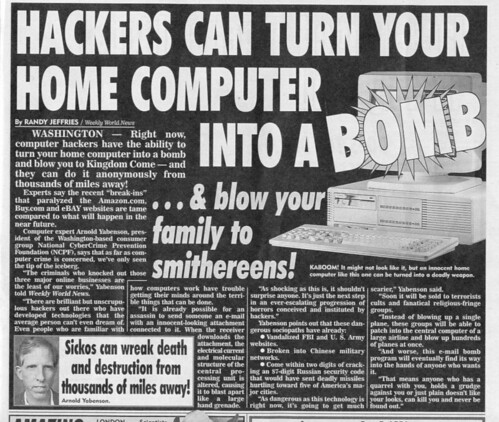
The other interesting thing presented in the article was the media’s effect on the American public. Hacking at one point was considered a good thing, but with the media portrayal they turned the word into something with a negative connotation. It was also interesting to read the different article excerpts explaining possible terrorists attacks. They were either extremely vague with little details provided by the sources or just looking to issues warnings by including places where a threat was possible. The whole idea of sensationalist reporting after 9/11 was probably done to sell more newspapers, but it also had an effect on the public by helping stir up fear within them. The media really does affect the public and its opinion. Its ability to do so should be considered in claiming terrorist reports or any type of article that might instill fear.

Friday, November 21, 2008

Don Sharp "Under the Hood" from Harpers Magazine June 1980


With the finishing of Don Sharp’s Under the Hood, we are official done with the $100 course pack. A very strange yet interesting two pages from what seemed like a grumpy old mechanic criticizing our society. The excerpt starts out by telling the reader that Don runs his own mechanic shop in which he fixes up cars real problems without scheming them out of money like a real auto shop would do. Sharp discusses some common car parts and how they work, as well as some common problems. He begins to talk about how mechanics really don’t understand what is going on under the hood and how they get paid in any event regardless if they fix your car or not.

Sharp speaks a lot about the “cause and effect” relationship and how both drivers and mechanics gave up worrying about this. Drivers assign responsibility for the car’s smooth running to someone else. They never believe that their actions were the ones that damaged the car. While the mechanic does not attend tot eh behavior of the car instead he consults charts and tries option B if A was unsuccessful. Sharp says two thirds of batteries, starters, alternators, ignition coils, carburetors, and water pumps that are sold are not needed. That if the mechanic knew enough about the car or decided to look deeper they would realize the true problem might only be cleaning battery terminals. He faults the people though saying if they decided to study the cause and effect of the events that took place under their hood they might be able to distinguish this problem and prevent spending all that money.

If people were more simulation literate they would be willing to accept responsibility for their machines it would added to the sense of individual worth and of the moral strength of the culture. Sharp says a person who looks into the cause and effect relationships shows a lot about their morals and character.

Tuesday, November 18, 2008

Lawrence Lessig Chapter 10 of Free Cluture (2004) Published by Penguin Press


The third and final Lawrence Lessig reading comes from his book Free Culture published in 2004. While CODE seemed to deal more with the regulation of cyberspace, Free Culture deals with the property owner’s battle versus new technologies. He concerns himself with the fact that certain powerful interests, such as Hollywood, are using copyright law to lock down the very stuff of creativity especially past creativity. We begin at chapter 10 and right away Lessig gets into what the framers of the Constitution wrote about property. How they wanted it protected and fair compensation given if it was taken, but they also said that progress is arts and sciences should be promoted. Copyright laws have ensured that authors have a property right in their work for a limited duration. Part of the reason for a limitation is that change has always drawn upon past culture to produce the new. Now that copyright is extended it has harmed the growth of new creation.

Lessig talks about the four different modes of regulation; they are law, norms, market, and architecture. Law is the act of being threatened or punished for violating a copyright rule and are usually imposed by the state. Norms are also punishments but imposed by the community. Market is a property law that defines what must be bought if it is taken legally. Lastly, architecture is a constraint on behavior usually through simultaneous conditions. All these constraints interact and help protect property.

Upon looking at the book, I couldn’t help notice the website that is featured on every page. The website leads to free downloads of the book in various formats as well as being able to hearing it read out loud. I thought this was very interesting; it’s the exact opposite way big business such as E-Book Reader acted with the Alice in Wonderland book. Lessig is obviously a very smart man and knows a ton on this subject; the problem is everyone is touched by copyright whether they know it or not. People need to get educated.

Thursday, November 13, 2008

Lawrence Lessig Chapter 4 of Code Version 2.0 (2006) Published by Basic Books


Part two of three from Lessig, this second reading is the next chapter in his book Code. He expands on his ideas that he brought up in the last reading. Chapter four is entitled Architectures of Control. Lessig spends much of his time talking about identity in the future, this is the who does what where aspect of cyberspace. He talks about how at first people were like the invisible man, no one was able to keep track of what people where doing. It is now in a more regulated state in which people can be tracked by three familiar ideas – identity, authentication, and credential. Identity consists of attributes of a person. Authentication is the evaluation of your identity, while credential is the device for authenticating. Lessig says that identity and authentication in cyberspace is getting better due to TCP/IP addresses as well as ISPs and cookies.

This chapter was much longer and more technologically intensive. The writing and content dealt a lot more with the actual details of computers and cyberspace. The ability to have people know who is surfing what where on the Internet greatly benefits us. It allows for websites to be customize based on geographical features and allow for a webpage to have a more personal feel to each user.

Lessig also talks about how the unregulability was a product of design and that the failure of the network to identify who someone was, and what they were doing meant it would be difficult to enforce rules upon them. Now with the newer technology bridging these gaps many commercial interests have come about, such as online purchasing. Of course new problems arise such as viruses, ID theft, and spam, but this only shows the world that there is still a lot of unregulable behavior out there.

Tuesday, November 11, 2008

Lawrence Lessig Chapter 3 of Code Version 2.0 (2006) Published by Basic Books


The all-important fallacy of the “is-ism” is an interesting subject; it is the mistake of confusing how something is with how it must be. Lawrence Lessig looks at this fallacy in depth in chapter 3 of his book CODE version 2.0. He puts to bed the rumor that the Internet cannot be regulated. He says that all technology is plastic and can be molded and remade to do whatever we’d like. Lessig touches on the differences between University of Chicago and Harvard’s early Internet systems and relays them into the three “bugs” of Net95 – imperfections that limit the data that the Net collects. The imperfections are the information about users, geography, and use. With these imperfections corrected, the Internet can easily be regulated.

Allowing people to change version one on a Wiki created Lessig’s version 2.0. In today’s age the Internet is indeed regulated, but its understandable to see when he wrote the original version how different the rules were and exactly how far we’ve come. As Lessig says the nature of the is about to flip and he was certainly right.

The most interesting part of the chapter was the differences between the two prestigious universities and their actions with connecting to the Internet. Chicago allowed for free, and completely anonymous use. Harvard on the other hand wanted login credentials and needed the machine to be registered and approved. They would then monitor the network being able to see what the person was doing. It’s interesting to see how different places respond to different technologies. Nowadays the standard practice at all colleges is to register for the network and all their actions can be completely monitored. Back in early days of the Internet it was possible to be unwatched. Now, Big Brother is everywhere.

Thursday, November 6, 2008

Tales from the Public Domain Bound by Law? by Aoki, Boyle, Jenkins, For DUKE University 2006


Before I start discussing the comic book Bound By Law? by Keith Aoki, James Boyle, and Jennifer Jenkins, three law professors from Duke University, we should clarify some definitions. The two words discussed most in this comic were public domain and fair use. The public domain is comprised of material on which copyright never existed or has expired and, hence, can be freely used by the public at large. Fair use is a statutory exception to the copyright laws that allows use of portions of copyrighted material for a variety of purposes as long as the use doesn't exceed the boundaries of a four-factor test the law establishes. The comic follows a filmmaker who wants to make a documentary of the day in the life of New York City. Except almost everywhere she goes there is copyrighted or trademarked material: music on the street or in a nightclub; a program or movie on the television in a particular room; or the logos that are ubiquitous at almost any sporting event. To figure out if she can use any or all of these materials without being sued for copyright infringement, she needs to sort out whether the material is protected or in the public domain, she gets her help from two obscure figures as the narrator calls them.

While I was extremely confused by the text and the set up of the comic, it did a good job demonstrating the seemingly endless circles and mazes in which an artist or writer can be led trying to sort out these questions. Bound by Law? also frequently relies on a very childish approach that displays how material which may or may not be in the public domain or may or may not be copyrighted plays a role in the expression of ideas. Due to the authors being advocates of fair use, the book is filled with copyrighted and trademarked images, logos and symbols. Thus, the comic book not only illustrates but also makes a point far better than a traditional written work. Not only does it show the firsthand impact of the problems, it also educates about a variety of court decisions.

Bound by Law? acts as an incredible legal comic book educating the uneducated on the subjects of fair use, copyright, and public domain. As an inspiring filmmaker this comic will be helpful to me. Learning about what I can and cannot do at such an early age will certainly help me in the future. The comic will most certainly need to be read to fully process these confusing laws. With these rules its almost like the rich get richer and its hard for new people to break into the business. I think the world would be better if rights weren’t protected and a large lump sum of money was given, but I know that’s not going to happen. It should be not about the money but about the love of the product you’re distributing.

Monday, November 3, 2008

Farmer and Mann's Surveillance Nation from an MIT Technology Review May 2003


The two-part Surveillance Nation by Dan Farmer and Charles Mann was an interesting look at the new and budding technology that is beginning to come into fruition and threaten our personal privacy. Granted the article was written in 2003 and the technology in the last five years has probably advanced even farther it was fun to read about some of the things that I already did not know about. The article starts out speaking about the traffic cameras and other technology that analyzes car data while driving. They transition into RFIDS, databases, GPS, and surveillance cameras. The constant theme they speak upon is where this data goes and who is actually watching and recording it. Farmer and Mann speak mostly about how the government and big business are the ones using these technologies, but part two starts about speaking about how personal surveillance systems for homes has increased by a factor of ten over the last couple years. This means more and more people in their home environment are protecting themselves with cameras. The article ends speaking about how both surveillance technologies can do both a lot of good and harm depending on whose using it and for what.

Part two of the article spoke about the new Malaysian smart card chips that contained all your personal information on a chip on your ID. I thought this was a very smart and easy way to keep all your personal information together, but there are some risks to it. If your ID is taken criminals can now know all your personal information including credit card information as well as heath records. A person’s entire life can essentially be read from this chip. It does come in handy though having all personal information in one spot, but the security risk does not make it practical. Technology is forever changing and new and safer ways to share information is constantly evolving.

I’ve said it before but there is no right to privacy specifically stated in the Constitution, it is just a combination of a couple of amendments that the courts have read as a “zone of privacy.” With technology constantly evolving and privacy slowly being invaded by cameras and other things, it will be interesting to see how the government or courts interpret what is invasion of privacy in the future.

Wednesday, October 22, 2008

Facebook's Privacy Trainwreck: Exposure, Invasion, and Social Convergence" by Danah Boyd From Convergence (2008)


In 2004, Harvard student Mark Zuckerberg launched the social networking site Facebook. Originally open to only college student, it expanded to high school and eventually to all people. Danah Boyd’s “Facebook’s Privacy Trainwreck: Exposure, Invasion, and Social Convergence” gives in a depth look at September 2006’s newest addition of the ‘News Feeds’ to Facebook. The ‘News Feeds’ allowed for users to see various information recently preformed by Friends. News Feed highlights information that includes profile changes, upcoming events, and birthdays, among other updates. News Feed also shows conversations taking place between the walls of a user's friends. The information given in News Feed was public to all if one was so inclined to search their friend’s profiles for it. The New Feed caused much of a stir due to privacy issues. Boyd’s article discusses people’s discomfort from two angles: exposure and invasion.

As a Facebook member since 2006, I must admit the New Feed did not bother me, but maybe because I had only been on Facebook for a couple months. I could understand how people felt vulnerable, thinking their dirty little secrets were being shared with the world. The secrets were not being shared with the world, only their Facebook Friends, friends that they accepted or friended themselves. After the initial uproar Mark Zuckerberg apologized for the new feature. He explained the new privacy features that would limit people’s “secrets” from popping up on others News Feeds. People were able to limit their exposure to others. While this aricle says the News Feed does not distinguished between friends, it treats them all like equals I must disagree. My News Feed is usually filled with information strictly from people whose profiles I constantly view/view frequently.

While Facebook is heads and shoulders above MySpace on the privacy level. All the time you would hear about predators lurking on MySpace and sexually assaulting others. Facebook has not been used in this way. Due to the “friends” counters on MySpace young girls would try to build that number up by accepting strangers, Facebook was not open to young girls are first making it safe from predators. The other great use for Facebook is its ability as a networking tool. I try to friend everyone I come in contact with for the mere fact that maybe later in life I will need him or her for something related to my career. It allows for me to keep in contact with them. Mark Zuckerberg says the purpose of Facebook was to help people share information more efficiently. People should not complain when things like News Feeds are added. They know what they were getting themselves into when they signed up. They have the option to set their profile privacy.

Its ironic people would complain about this since there is no clear right to privacy specifically laid out in the Constitution. I feel like in this digital age where information is so easily obtainable on the Internet eventually new laws are going to be needed to protect us.

Monday, October 20, 2008

Mobilising of the Social by Michael Bull: Chapter from the book "Sound Moves: iPod Culture and Urban Experience" 2007


Michael Bull, or as he is known as in his field Dr. iPod, is a professor at the University of Sussex. Reviewers of his novel Sound Moves: iPod Culture and Urban Experience claim he is “the world’s only expert on the social impact of personal stereo devices.” Chapter 6 was entitled “Mobilising of the Social: Mobile Phones and iPods.” The subsequent 20 pages speak about the pros and cons of the mobile phones using personal interviews. He then goes on to conduct interviews with people who use iPods and compares and contrasts them with people who heavily use their mobile phones with people who do not heavily rely on phones. Bull makes a case for almost all the possible combinations of use between the cell phone and the iPod and lists the types of categories people would fall under depending on the usage.

The chapter starts out with the mobile phones ability to allow for “total availability” of a person, in which people no matter what the time can contact you. He believes privacy is endangered with use of a cell phone and that this concept is spilling from the business world into the lives of every day people. Bull states mobile phones are used to represent an external intrusion into the private world and an iPod is used to block out those external interruptions. Bull looks at cell phones as a “necessary evil.” He thinks iPods allow for their users to create a personalized sound world and allows for intense pleasure. He concludes mobile phones connect others and iPods to the self.

It was quite interesting and comical reading this chapter. I couldn’t help but see myself in the some of the stories and “diagnoses” that Bull creates. While I am not obsessed with my cell phone, I can have it off and feel fine, I know people who are. Some of my friends go insane when phoneless. They feel like the world is passing them by and have no way of keeping up. Since they cannot call or text they constantly worry if someone is trying to find them or ask them something. I recently lost my phone for two days. I got by just fine, but I will admit I felt a little naked. Just out of habit I was checking my pockets to see if they were vibrating while walking to class. When I got my phone back I had 5 new voicemails and a myriad of texts, but like some people in the interviews I would choose my iPod over my cell phone any day. My iPod is my child. Its customized and personalized for my life, my phone is just allows me to keep in touch, we have e-mail and AIM for that. When working out and walking to class my iPod is my entertainment and my joy. I command it, while my cell phone bosses me around when getting a call or a text. I like getting away and the idea of not being totally available 24/7. Everyone needs to have peace to themselves and putting on your favorite CD and just relaxing is the perfect way.

Tuesday, October 14, 2008

Technology and Ideology by John W. Carey Chapter 8 of the novel Communication as Culture 1988


In John W. Carey’s epic chapter Technology and Ideology: The Case of the Telegraph from the novel Communication as Culture he pleads his case about how the telegraph is one of the greatest inventions of all time, changing the landscape of the world. He speaks about how the telegraph was the first monopoly and allowed for the creation of capitalism. Next he goes on to speak about how the was the first of the science and engineering-based industries. His next two points discuss how the telegraph changed the nature of language and how it was a watershed of communication. Part two discusses the religious actions of the telegraph, with part two discussing the changes in the market. Part four speaks about how the telegraph changed time in the United States.

The bulk of Carey’s writing details how the telegraph split communication and transportation. It rearranged the market place in the late 1800’s after it began being used as a widespread tool for communication. People no longer needed to see what they were purchasing. Good could cross state lines after being ordered via telegraph. Arbitrage, buying goods for cheap in one state and selling it where it is in demand in a different state for a higher price, began to deteriorate due to the telegraph. All states for the first time were on an equal playing field. They could instantly communicate with one another and figure out prices in other states. It uniformly standardized goods. People also began to test out the futures market, which projected future costs of goods in order to make money. Speculation trading is still very big today when playing the stock market.

While it was a very informative 30 pages the mere fact that it was speaking of a technology that I have never come in contact with deters from it. I could not relate to what the telegraph brought to the country for the simple fact that I was not alive to ever use it. Carey obviously regards it as a life changing invention though. The most interesting part of the article is that our time zones were created due to both the railroad system and the telegraph. It’s amazing to think prior to that time zones changed every few hundred miles depending on the state. Its interesting to see in a hundred years what authors will be writing about that defined our generation technologically due to the massive improvements. Will it be the cell phone? The computer? The Internet? All of these inventions changed the market place in their own right, I guess only time will tell which was the most influential.

Monday, October 6, 2008

"An Update on the Effect of Playing Violent Videogames" by Craig Anderson from the Journal of Adolescene (2004)


“An Update on the Effects of Playing Violent Video Games” by Craig A. Anderson was the first scientific write up we’ve had to read. This made it very difficult to comprehend. The article was published in the Journal of Adolescence and it is very clear that the audience for it was scientists and physiologists. The reading was filled with high-end vocabulary and the way he followed the scientific process in attempting to sort out his findings. Anderson first introduces to past findings that have taken place with the use of violent video games and discusses their shortcomings. He thing begins to explain to the reader how his meta-analysis is being sampled and what factors he is looking for. He outlines the experiment and finally discusses his results and what they all mean.

The most important information I gathered from Anderson appeared in the last five pages. The results clearly stated that playing violent video games was associated with increases in four of the five variables he was testing. The only variable that had a decrease was helping behavior and that also was a cause for alarm. The five variables he tested for included aggressive behavior, aggressive cognition, aggressive affect, and physiological arousal. All four of these increased when kids and teenagers played violent video games. None of the variables tested contained zero in a 95% confidence interval meaning the data is not statistically significant, meaning they did not occur by chance. I took statistics last year so I am familiar with evaluating data in scientific results. Based on these results, Anderson states three facts about violent video games in his discussion, but I believe the effect video games have on children is quite overstated.

The knock on violent video games is that they make children violent and disturbed. I completely disagree. I believe it’s the parent’s fault and not video games, television, or even music. My brother and I grew up playing Grand Theft Auto, watching movies with psycho killers and gore, and listening to Eminem, but none of these things have influenced our lives in the slightest. People who are crazy and had distraught childhoods do things like Columbine and bombings. Killing people in a video game should not make a child go insane unless he is brought up in a household here he or she already hanging on by a thread. I believe video games and music and movies can push a person into doing awful things, but it’s the parent’s job to keep them from ever getting that close to the edge.

Wednesday, October 1, 2008

Our Cell Phones, Ourselves By Christine Rosen: Magazine Article for The New Atlantis Summer 2004


Christine Rosen’s Our Cell Phones, Ourselves discusses in depth the national phenomenon that is cell phone use. She starts by discussing some statistics over the last couple years involving phones and how they are an integral part of our society. Rosen talks about its two main reasons people own cell phones, safety and convenience. The article also goes into less obvious reasons people own phones such as to display their status in life and symbolically show power. The article then shifts to talk about some of the dangers of cell phones that have evolved due to its ease and abundance of numbers. Lastly she begins to talk about how society has become inconsiderate with its cell phone use. How the zone of privacy that every person has has slowly diminished due to new technological advances. She makes the argument that society has lost its civility.

This was a very strong article. It was a very well put together lengthy look at how society changes when a new technological invention is distributed to the masses. The article was written four years ago and some of the ideas are more prevalent nowadays. The dangers that she reveals are ahead of its time and are now at the forefront. States have outlawed driving and talking on the cell phone. iPhones have been hacked and personal information taken from them. People are addicted to cell phones, especially young girls nowadays with their Blackberrys. One can constantly hear personal stories of kid’s crazy weekends by just walking the quad. Rosen is right, we are not merely overhearing, we hear as if we are the ones the person is talking too. People have slowly lost bearings when it comes to cell phone use. It’s no longer a private phone call. People speak loud and speak proud regardless of what they are talking about. In ten years what will this situation be like?

If the same evolution continues in ten years there might not be such a thing as technological privacy outside of your own house. The “social space” has shrunk to an all time low. On Macs one can screen share with another Mac user giving them access to the other persons computer. What’s next? Rosen’s solution to how to stop these unwelcome damages is an interesting theory. If we can treat cell phone use like tobacco use maybe we have a chance to save the little privacy we still retain. Maybe the people of the world can once again regain the civility we once had.

Thursday, September 25, 2008

"Seeing Through Computers: Education in a Culture of Simulation" by Sherry Turkle November 30, 2002. Article Appears in "The New Media and Learning"


“Seeing Through Computers; Education in a Culture of Simulation” by Sherry Turkle was written at the turn of the century in 2002. It discusses the two definitions of transparency and what they mean to the two generations of computer users in the world. Turkle explains that the older generation, people over 30, sees transparency as an ability to “open the hood” and poke around. In other words to know how a computer does what it is. To the younger generation who grew up with computers, transparency just means being able to use it correctly. Sherry also speaks about organizations such as MassCUE, which consists of computer using educators, which want to teach students the Logo programming language because they believe it’s a very important skill to know. The educators are part of the over 30-age group which can be known as the culture of rules. The students live their lives based on video game simulations, which do not teach them real life scenarios.

Turkle’s argument is an interesting one. She is a professor at MIT and obviously she group up loving numbers and learning how to work new technology, I can see why she would be one of the people who side with the rules. My argument though as a new resident in the generation of simulation is why should I care how my computer works as long as it can work? Do I ever need to fix it or open the hood and poke around? I do not. I can call someone to do that for me and fix it. In today’s society we have experts in those fields who get paid to do that. I can understand hands on people wanting to know and understand the technology they use but for the most part I don’t see a need. We relay on computers now a day, there is no need for me to understand how it does what it does, as long as it makes my life easier.

Simulations are defined as a “representation of the operation or features of one process or system through the use of another.” What do simulations do for us? They make collecting data and figuring out consequences and possible outcomes easy. They are less expensive than doing the real thing, for example a flight simulator. If you crash in a simulation, no harm no foul. If you’re practice on a real plane and crash there are devastating consequences both financially and physically. Why the older generation does not accept these is beyond me? They are programmed to be if not 100% accurate as close as possible. There is no reason people should be in simulation denial. Simulations are not a destructive force but a tool for education. Nowadays we learn from computers if we can’t trust them then we cannot trust most of the computer driven technology is our society.

Monday, September 22, 2008

The Unreal Thing: What's Wrong With The Matrix? by Adam Gopnik: May 19th, 2003 The New Yorker Magazine Article


The title of this piece by Adam Gopnik, which first appeared in the New Yorker, is quite misleading. Upon first reading and seeing the words “A Critic At Large” at the top, I was expecting a movie review of some sort. At first the article begins to show The Matrix as a cult, speaking about the following that it has evoked, but then it begins to talk about the premise of the first movie and what made it so epic. Gopnik describes Neo and Morpheus’ quests and also speaks about the Cathars, a medieval Christian group, and their beliefs that possibly inspired the movie. After all the background knowledge he instills upon the reader he finally gets into the two horrible disgraces that were the sequels. He touches not only how terrible they were, but how they destroyed everything the first created. He wraps everything up with a lot of philosophical information that also too might have helped inspire the Matrix. He ends by saying that the Matrix is ahead of its time due to what has happened in our society over the last couple years, which I agree with.

Why do I find the title of the piece misleading? It is for the mere fact that he doesn’t find anything wrong with The Matrix; his quarrels come with the two sequels. The Matrix was a mind-blowing and brilliant movie that expanded the minds of the millions of people who watched it by allowing them to question their existence. A movie that has the ability to do that will stand the test of time as a classic. In classrooms all across the country, kids and teachers discuss what if this wasn’t real? What if people are just a speck of dust in a computer in this place we call the universe? I love philosophy. I think learning about existentialism, absurdism, and nihilism are things that all people should have to be exposed too, this is probably why I took such a liking to the Matrix. I agree with Gopnik on his points about the sequels. They were awful. They took the fun, the thought, and the complexity out of the movies. They became too commercialized in order to appeal to a wider audience so that they would gross more in the box office. It was also apparent that the Wachowski brothers never intended for a sequel to be made and instead tried to create another epic piece of work to no success.

The second part this article goes into is some of the literature of famous sci-fi writers and philosophers who might have had a hand in creating the dream world that was The Matrix. It also hits on how ahead of its time the movie was. The Matrix was about political freedom and social change in a world that was controlled. Today’s world is the same way. We, the people, are not equal anymore. The government and big business is suppressing what the majority wants in order to profit. The stock market is in shambles, and we have lost control and are now a dependent nation. We need to “free our minds” and start voice our opinions and standing up for what is right.

Wednesday, September 17, 2008

High-Tech Trash by Chris Carroll: National Geographic Magazine January 2008


I was highly disappointed with this article by Chris Carroll. I am a big National Geographic fan, but I thought this article was not only dull but also poorly written. Maybe I am being a little bias since I read it after seeing Exporting Harm, but it seems to me that it was a less informative version of that movie. The pictures seem to come right out of the movie with the scenes of large warehouses filled with computers and Chinese men and women slaving over hot stoves to gather copper and other valuable metals. The article did not do a good job telling the public about the hazards that are in these e-waste dumps in China. The movie was a lot more informative and hit a nerve with me that the article did not. After the movie I felt for the people of China and other places that this dumping goes on too, but this article did not make me feel the same way. Which is unfortunate since plenty of people might read the article and not see the movie. Carroll’s words are not painting the picture and as a result people might not find the dumping of electronics to be a problem.

I’m no saint, I’m very sure that I have contributed to the cause by not properly recycling and throwing out electronics; now I will be a little more conscious of my acts knowing that they are affecting the less fortunate. I think its terrible that the government will not ratify the Basel Convention due to losing profits. It once again shows me that the propaganda video we first saw is correct. The government is being run by big business and until that changes normal people will not be able to have a fair say. We are lucky though that some people like BAN and Creative Recycling Systems are taking matters into their own hands and trying to make things better overseas. People fighting for a cause is the way that problems like this are shown to the public and eventually become solved.

Lastly, the article’s only really great point that was not in the video was the last paragraph. I didn’t even think that the high levels of lead all over China contribute to the high levels of lead in things like toys that get shipped to the US. It was a fantastic point brought up by Jeffrey Weidenhamer. The crisis we’ve started is coming back to us to bite us in the ass. Hopefully big business will take note of that and clean up their wrongdoings before more toxic imports come back and damage their company’s names.

Thursday, September 11, 2008

The Clean Room's Dirty Secret by Susan Q. Stranahan: Article for MotherJones.com March/April 2002


Definitely the most interesting of all the readings we have had to do so far. Instead of focusing so much on the technological side like we did with Levy and Winner, Stranahan brings to the forefront the legal side of our informational society and some of the health consequences that have evolved due to being around theses inventions. Cancer is a very serious disease. My grandmother died of cancer and my dad had a tumor on his kidney, which was successfully removed. It can show up in people with no history in their family at any moment in time and should not be taken lightly, so the fact that these big companies, where workers deaths have statistically shown “an elevated rate in brain tumors” over the last ten years, are not helping to protect their workers is crazy, (Stranahan, 2002). These workers put together the semiconductors in “clean rooms” filled with carcinogens and other toxic and reproductive health altering mixtures. How is that considered clean? Workers basically go into work and slowly die every day by being around these chemicals and the large companies pay their lawyers to try to sweep the statistics about health under the rug in order to save money. They say we live in the greatest country, but as that video in class showed, big business is larger than the government. No longer are the people the most important aspect, the government helps who brings in and makes the most money. People’s health and safety should be seen about profit but its not and I don’t think it ever again will be.

Thankfully these workers are coming out after all these years and suing IBM and other owners of plants for their negligence of not protecting them. While I’m sure both these companies and the government will do all they can to not allow these to go to court, I hope all the victims get their dues and fair compensation.

Lastly, my other problem with big companies and the way they do business is their criteria for calculating on the job injuries. The semiconductors industry is the 6th lowest, but it only entails on the job injuries, not possible chronic diseases that evolved from working. It may be a “Herculean task” to prove that the specific chemicals lead to these diseases, but its reasonable to say they’ve played a part in these fatalities, (Stranahan, 2002). Without these chronic diseases added to on the job injury rates shows another way how big business and government are able to manipulate stats for their advantages. Hopefully someone figures out how to actually make these “clean rooms” clean.

Wednesday, September 3, 2008

9/3/2008 Mythinformation by Langdon Winner Excerpt from the book "Questioning Technology" 1991


After reading the essay “Mythinformation” by Langdon Winner I immediately went to my computer and searched Webster’s Dictionary for the term “mythinformation” to see if in fact it was a real word and if that was its actual definition. Turns out it’s not. Winner, who is a professor of political science at Rensselaer Polytechnic Institute, in order to display the feelings of the era, created the word. In the midst of reading this essay I came across the line, “current dreams of a ‘computer age’ stand out as exaggerated and unrealistic,” (Winner, 1991). At first I was taken back since I believed that we were currently living in a computer age. After a minute of confusion I flipped to the back of the packet in order to see the date in which this was written. 1991 was the beginning of the technological revolution, slowly newer and better technology was being produced in order to make the lives of citizens easier. We now live in an era where everything is as easy as one would want it, yet surely enough even greater technology will be invented to help us out.

Winner speaks of the dangers of the new technology and I completely agree with what he thinks will be long-term consequences. As a science fiction fanatic, I’ve read and seen movies about the dangers of both artificial intelligence and boundaries beyond Earth. With technological revolution and the possible feasibility to monitor our activities, 1984 is the first thing that comes into my head. The government might eventually be able to see and hear all we do and use its power in order to turn our government from democracy into totalitarianism. This is obviously a possible farfetched and extremely pessimistic outlook but eventually boundaries will need to be set on privacy issues as even newer technology is created. Also, through technology like texting and Ichating today’s youth is losing its ability to communicate with other people. Social skills are slowly being lost with people due to their reliance on computers or phones to do everything.

The novel this excerpt came from is called Questioning Technology, seventeen years ago I could understand being apprehensive about the future and its new age wonders. The world we live in currently would not be the same without these new technologies, but as new inventions come into existence, will anybody have the guts to stand up and question them if our freedoms slowly dwindle because of them?

Monday, September 1, 2008

9/1/2008 Steven Levy "Perfect"... Chapter 1 of the book "The Perfect Thing" Published in 2006


Steven Levy is a technological beat writer for Newsweek, who happened to fall in love with one of the very products he had to write about. Apple’s iPod, now a life changing digital music player and my personal favorite gizmo, has come a long way since its release in 2001, but for Steven Levy to call it the “perfect thing,” I must disagree. Though he does state his criteria for perfect, specifically saying that it does not need to be flawless, the mere fact that the iPod has a myriad of flaws, such as battery life and its ease to collect scratches, does not allow me to believe the same way as him. Levy believes perfect can just be “making a dull day suddenly come alive,” (Levy, 2006). I understand in a spiritual sense that listening to your favorite album wherever you want, on a portable device will brighten the day, but so can many other things. His main reason for iPod perfection is the success that came along with its creation. Mac sales went through the roof and a new era of Apple users came into existence thanks to the newest technological craze. Does success imply perfection though? I listened to CDs and saw movies that no one has heard of that I consider to be perfect. Defining something as perfect is all about one’s opinions and viewpoints. I think that the iPod itself was the perfect marketing tool for Apple. It brought them back to the top of the technological world. The iPod’s creation and the hype surrounding it was the main reason for the sudden rise in sales for Apple. Without the creation of the iPod, Apple’s stock does not go up 700%, and sales in Mac do not increase, (Levy, 2006). I also believe that the iPod commercials and the marketing of the iPod itself was genius. The silhouetted people dancing with there white iPods in the foreground will forever be an iconic 21st century image.

Throughout the first chapter in his novel Levy looks to the iPod as one of the main reasons that he and many others got past the tragedy that was 9/11. He states that, “I wasn’t exactly forgetting about 9/11, but I was getting excited…about technology and its power to transform the world,” (Levy, 2006). People’s ability to walk or run with their own digital libraries in their pockets made life simpler. In a time that people all over were scared, it relieved them to see the world was still moving forward. The iPod can be thanked for that. It allowed people everywhere at any time to put in some headphones and listen to all the music that makes them happy and life seem grand. One iconic image, the iPod, momentarily allowed for the other 21st century image, the towers falling, to fade away.

Wednesday, May 28, 2008

All Over


I feel like I owe it to myself to return to the elite blogger I was in the third marking period so here comes to the finale that is sure to impress. It’ll discuss both my future and past in the English program here at Pascack Hills.

Let’s begin by congratulating me on my B minus on the final paper. The paper lacked examples but did include a nice thesis. My presentation will make up for the lack of examples by providing many as well as a plethora of audience participation. The audience will be taught how to write a screenplay as well as treatment and if they enjoy what they hear maybe we will one day see a major motion picture made by one of Mr. Saxon’s students.

Now let’s travel back in time to honors English I with Edward Sandt. One of the nicest human beings ever, he was a great friend as well as teacher. He began my high school career by teaching me the basics in writing a research and thesis paper as well as grammar and mechanics which I still lack too this day. I thank him for all he taught me though.

Next was Mrs. Harmon……

Then there was Mrs. Lutz. She was a lovely woman. One of those teachers who really got into what she taught. She became one with the characters she read. She was always happy and ready to fill our post pubescent minds with knowledge. I also thank her.

Lastly, Mr. Saxon, the newbie. He taught a nice satire lesson the year before and we instantly knew that he was the man. Luckily he turned out to be exactly what we first believed him to be and respected us and our senioritis. Third and fourth marking period while boring really allowed us to get away with just reading and doing projects a lot like what college would be like. I thank him as well.

Thank you for reading my blog and all its up and downs.

And I've known you waited so long so here is the conclusion to my favorite cds of all time list!

6. Wilco - Hotel Yankee Foxtrot
5. Third Eye Blind - Third Eye Blind
4. Rage Agasint the Machine - Rage Against the Machine
3. Modest Mouse - The Lonesome Crowded West
2. Radiohead - The Bends
1. Brand New - Deja Entendu

Tuesday, May 20, 2008

Project Up Next


Well I thought the adventures in blogging were complete, but clearly I was wrong. Friday June 13th I get to present my project in its entirety to the class, it will be a joyous day because once that’s complete school is really over! That day can’t come soon enough, I’m actually kind of upset I didn’t volunteer to go first, bad move on my part. This long layover does give me a lot of time to perfect the powerpoint which will consist of the sources I used in writing the screenplay as well as a model from my script, the treatment I come up with to sell it to the studios, and possible actors and directors for the parts. I will have to throw in some other assorted items that will help the class get involved as well as some tech stuff to quench Mr. Saxson’s thirst for blogs and wikis.

My blog used to be the best but has slowly gone downhill due to lack of effort. I hate being in school now, there is no point in coming any long and my nonchalant writing shows that. I cannot wait to end school, have a great summer break, and then start up with my first year of college. I just want this last month to fly by with no bumps and finally just end with my graduation.

Monday, May 12, 2008

Last Post Before the Due Date


Well we’re approaching the dreaded due date for this horror research paper and I have to say it’s basically writing itself. In the two periods I actually worked on it I have written three paragraphs and about two pages double spaced. I am well on my way to easily completing this paper and it is a great relief. The most obvious weekly goal is to buckle down and finish the masterpiece. Since the combination of my great mind and the lengthy sources I have acquired over the way it should take no more than a few days if I work the minimum on it each night. The thesis is strong and the topic is interesting and not yet been tackled in class. Hopefully it’ll turn out to be a great lead.

After the papers done I can spend the rest of the time is spent completing the around 90 plus page screenplay. I anticipated having a bit more time to work on it so I’m not 100% sure I can complete the whole thing in three weeks but I will do my best.

Monday, May 5, 2008

Getting Closer


The picture describes exactly how I feel. Another week gone and another week I have yet to accomplish anything with my research project. At this point in time I’m more focus on the actual screenplay, which I have been frivolously working on. I did contact the author Henry Garfield and he was quite excited to see I wanted to use his novel as my muse. He also requested a final copy, which I will gladly send him. As for school, I have all but given up. I don’t like coming anymore and after Wednesday when my AP tests are complete it will officially all be over in my mind, hence the lack of work I have been doing on the paper. I am passionate about movies and writing screenplays, but there is no passionate when it comes to doing any research. I will, of course, finish the paper by the deadline, but will it be any good remains to be seen. So the goals for the upcoming two weeks are as follows:

1) Find websites related to the history of the horror genre. This includes literary criticism databases as well as Questia, which I believe will be where a majority of my findings come from.
2) Begin the paper (quite self explanatory)

There are the week’s goals, if all goes well I hope to have at least a first paragraph with a beautiful thesis by Friday. If that can be done, the rest will be easy.

Monday, April 28, 2008

Home Stretch

After a rowdy week in Mexico with Doug, its time to kick it into overdrive and finish up the year right. During the week outside the United States I spent my time wisely rereading Room 13. The novel was as good as I remembered it to be and could really visualize it as a movie. The characters are interesting, the dialogue witty, and the plot captivating. I have also finished The Complete Idiots Guide to Screenwriting. With these two books completed the final project is shaping up very well. I am now ready to sit down and actually start writing my first screenplay. Some obstacles to overcome first though, I don’t feel right adapting the screenplay without talking to the author first, so my next order of business is to email Henry Garfield. I will inquire about possibly buying the rights to the book if it’s cheap enough. Next, I have already created a teaser trailer in my head that I will film to show the class while presenting. It should be a great way to visually show my project and not just present a script.

In the upcoming week I will hammer out what exactly I want to do for my mid-fourth marking period project. I think I will write a paper that involves the differences between original and adapted screenplays, but it could spin off to be something that contains the whole movie making process in general. I will have to talk to Mr. Saxon again before I definitely decide. There are plenty of online and in print resources that will help me along the way. I'm not really excited to write the research paper, but I know the final project is going to be great.

Monday, April 14, 2008

Back With a Bang - 4th Marking Period Style


After a lovely three weeks off, Darren Bleckner is back to writing his Pulitzer Prize winning English blog. In the fourth marking Period I will be taking on the difficult task of adapting a screenplay based on a novel. I know what you're thinking, "Darren, an adapted screenplay? You're better than that!" While I know I am superior writer than taking someone else's work I have to say a few words about the novel. Room 13 by Henry Garfield is one of the best and craziest "horror" novels I have ever read. (I will of course reread it in order to adapt it, don't worry Mr. Saxon) It has every thing from werewolves to haunted paintings and crazy sex scenes. To give a small back story, after a tragic death a teacher moves towns into the haunted room 13. Sounds great right? Oh it is!

I'm sure they're are a lot more questions, like how can you write a screenplay? Luckily through the power of written media and the internet there are plenty of things out there. Such as websites like Screenwriting.info and Empire Contact. It doesn't just stop at websites though there are plenty of books that screenwriters should read before jumping into the long difficult process that is writing a script. I will also read at least two full length books about the process while reading the novel over and starting the screenplay.

On to my plan for this week! In class I will either be reading Room 13 or one of the screen writing books, the other I will read at home. I hopefully will finish both books and a ton of websites by the time we return from vacation. This way I can spend the last sevenish weeks purely writing. The final project along with the physical copy of the script will include a power point on my methods to how I wrote it. As well as both a trailer and story boards. Lastly it'll include a treatment and possible actors and directors that will be lined up for the project. Hopefully one day it'll get the greenlight and Room 13 will be a reality.

Tuesday, March 25, 2008

Weekly English Post #7 - The Finale

Well it all comes down to this, the last post of third semester senior year English. We’ve had some good times, some bad times, some angry times, as well as some thoughtful ones, but its time for it to come to an end. The last post will be a potpourri of elements due to the simple fact that I once again am lacking the creative knowledge to proceed with something original.

I’ll start with what the last post lacked which were any details about the stories I had read. The Sunflower by Simon Wiesenthal was an emotional experience of epic proportions that awakened ancient feelings in my bottomless pit of a heart and allowed me to revaluate my life and what the word forgiveness actually means. The book itself wasn’t the sole reason of my newfound enlightenment but I also found it through the criticisms. “Dictionary definitions are inadequate in that they stress "pardoning" or "absolving" a wrongdoer from his bad deeds. Yet many would argue that wrong is never "righted" or "forgotten" through forgiveness,” (Lamb, 1996). I concur; just because someone “forgives” doesn’t make things right. The act of forgiving is a lot more serious than an “I’m sorry.” Its got to be felt in the soul and no more bad feelings can be between the two parties for it to be in its truest form.

I believe that the Christian religion with their "confession” the priest will always forgive them regardless of what they have done, and inside it makes the sinner feel better about himself. In reality nothing was changed. That person is still a sinner but they walk away thinking they have a clean conscience even though they don’t. It seems as if it teaches the wrong message. I think it’s a shame that people think they can find forgiveness for what they have done through a third party. They think that their priest can absolve them of all their sins even though it was not whom they sinned. Even if it will be tough to express one must ask for forgiveness from who they have sinned in order to truly be forgiven.

Those are my thoughts on forgiveness and I’m sorry if they offended anyone.

Sunday, March 23, 2008

Weekly English Post #6 - My Worst Post To Date

It's going to come as a shock but I have nothing to write about this week at all. I have funny stories to tell about the following week, but about books or English in general I have nothing. This may be due to the fact that I have finished all three books in record time and now must finish the last two projects. I will start this weeks blog off with the good weekend stories. Krock Radio called me on Friday to tell me I had won tickets to see the Pink Floyd Laser Spectacular at Nokia Theater at Times Square. The show started at 12 at night and lasted till 2:45 am. It was well worth the trip and the time. It was a visual experience not to be missed, including lasers, 3D glasses, and strange visuals galore. Add in the fact they played both Dark Side of the Moon and The Wall in its entirety and you have yourself a hippies dream. I cannot say I've really ever listened to Pink Floyd, but I know have a new found appreciation for them. They were able to compose some of the strangest yet compelling songs I've ever heard. Next week I make the trek back to Nokia Theater to see indie rock tour of the year, Say Anything, Manchester Orchestra, and Biffy Clyro. My last music point of this post will be that I will soon be updating my favorite albums ever! Don't worry, I've just been busy.

So I've read the three books needed to do four projects, to recap if you haven't been reading my blog I've read The Sunflower by Simon Wiesenthal, The Bluest Eyes by Toni Morrison, and Herland by Charlotte Perkins Gilman. All the books were easy reads and they all had interesting individual components which were described in depth in each post. Overall the three books lacked the elements to make them a good book in my mind. I usually do not like the books school chooses for us to read (senior year books were good minus these three and Hamlet). So since I have nothing interesting to speak about
I'd like to describe my criteria for a good novel with a little help from some friends.

1) Characters are Believable and Realistic (in comparison to setting).
I compare reading a novel to watching a movie. If I'm watching a movie and the characters are being stalked by a killer and decide to split up I automatically go, "Wow what a terrible movie." If the characters in a novel do things like that, are obnoxious and annoying, or speak unrealistic dialogue then the novel is considered bad.

2) Villian is not Dumb
If the villian has captured the hero and heroine and decides to spend time and tell his diabolical plan instead of just killing the hero right away, the book is bad. If the villian is smart though and in the end just gets outsmarted then the book has hope.

3) Climax is Satisfying
If I'm reading and the bombshell comes and I'm blown away, thumbs up for the book.

4) Loose Ends are Tied
If the novel ends and I don't sit there scratching my head then its worthy of being considered good. On the other hand if the novel ends and I feel used I'll rip the book up. NOVELS SHOULD NEVER HAVE SEQUELS!

5) Originality
Having the brilliant creative mind I have its not often that I've read story that I myself have not previous thought of. So kudos to the authors that shock me with newness.

6) I Can't Put it Down
Obviously the most important and basically a culmination of all the above categories, if the story can be read in a matter of days or hours then its considered a good book. I have a short attention span so while reading if my mind is not jumping and I can focus solely on the story BAM! Recipe for success.

Thursday, March 13, 2008

Weekly English Post #5 - Reflection Period


Another week gone, and another book read. This week while sitting in a New Orleans airport waiting for the flight back to Newark I sat down with The Sunflower by Simon Wiesenthal. The story tells the tale of a man in a German concentration camp during the Holocaust. One day while working outside of a hospital a nurse leads him into a room where a dying Nazi confesses his sins and asks for forgiveness. The book ends with Wiesenthal telling the reader, “to ask yourself the crucial questions, “What would I have done,”” (Wiesenthal, 1969)?

As a man of the Jewish faith, I thought the story would be an interesting and emotional read to see what my Jewish brethren had gone through. Throughout Hebrew school we have heard the horror stories, but The Sunflower was a different kind of horror, an emotional horror if you will. The enemy who has murdered millions of innocent lives asks you to forgive him for his crimes. What is one supposed to say to that? Simon Wiesenthal’s first hand experience shows both the thinking and actions that one might go through if put in this situation. The back of the book is filled with interesting criticisms from authors, teachers, and world leaders. Of the most interesting is Eugene J. Fisher. who believes that "we have no right to put Jewish survivors in the impossible moral position of offering forgiveness, implicitly, in the name of the six million. Placing a Jew in this anguished position further victimizes him or her. This, in my reading, was the final sin of the dying Nazi" (pp. 132-33, 1997). While reading the book all I could think about was what Simon was going to do, but looking at the big picture Fisher hits the nail on the head. The Nazi while in his deathbed is still able to inflict damage on the suffering Jews. He poses a question that is able to eat away at Simon’s surface, years later coming back to the for front of his life still in search of an answer.


If I were put in this situation how would I react? What I find more important is how would today’s generation act? I wanted to pose myself this interesting question for the simple fact that today’s generation is not nearly as religious or up to date on their respective faiths. I was one of those “bad” Jewish children who went to temple had the bar mitzvah and basically cut off all ties with the temple and religious aside form holidays I’m forced to attend. While I don’t necessarily think religion is a bad thing I believe you can have a “connection” with God by yourself and you do not need a church or synagogue to pray, it can be a personal thing. Also, I believe religious brings out the worst in people. For years different groups have been fighting and killing in the name of God. I don’t think that’s what God had in mind. Students nowadays believe “God is an afterthought at best. And the afterlife is, as one of my students told me, "on the back burner,”” (Prothero, 2008). With the millennial generation losing faith in religion it makes The Sunflower that more important. The more I think about it, the more it pains me to tell say that I would probably for give the dying Nazi in today’s day and age due to the simple fact that I don’t have that religious connection that people back then did.

Thursday, March 6, 2008

Weekly English Post #4 - Some Insight


I finished The Bluest Eyes by Toni Morrison last week on the plane to Indiana University. It helped passed the time while I was flying over the Midwest. I am not going to rant and hate on the book anymore, I did enough of that in the last post. The book ended decently, but was overall a sub par book. Now its time to be focusing on the project I’m going to do, I think I’m going to do the Imovie of a dramatic reading. There is a perfect scene in the book at the end with Pecola talking to herself in the mirror. She is admiring her eyes and due to the abuse she sustained, she has created an imaginary friend to speak too. I believe I can direct this scene very creatively and make it a good watch. While I have trouble reading out loud, I’ll do my best speak clearly (possibly with an accent) and act it out well.

Before I finally decided on the dramatic reading I was thinking about possibly doing the compare contrast essay based on a short story by the author. So I used the Internet to see what other novella/short stories Toni Morrison wrote and the only one that came up was one called “Recitatif.” Recitatif is defined as the tone or rhythm peculiar to any language. I found the title as well as the story to be very interesting. The story centers around two characters, Roberta and Twyla, one of whom is black and the other white. The most intriguing part of the story is the fact that Morrison does not tell the reader which one is which. They first meet while rooming together in an orphanage. What follows is five different vignettes with the girls meeting at different ages in life. All scenes portray the characters in different lights with different attitudes towards one and another.

Due to the lack of information about each character it allows for the reader to formulate his or her own opinions. Morrison intentionally restructures “the drama of ambiguity so that it involves the reader in the impulse to fix racial meaning and to know the racial status of its characters,” (Bennet, 2001). Upon first read through of “Recitatif” I thought Roberta was the African American due to the fact that her mother wore a large cross, carried a Bible, and refused to shake Twyla’s mom’s hand. As the story progresses I switched my opinion and began to think Twyla was the African American. That’s the beauty of the story, Morrison leaves the story up for interpretation and allows the reader to think the whole time. The story refuses to solve the mystery of racial identity and instead asks “its readers to examine the importance they place on fixing racial identity, hardly allowing them to remain passive readers or disingenuously uninterested.” (Bennet, 2001).

Tuesday, March 4, 2008

7. Eminem - The Slim Shady LP


The only rap CD to be on this infamous list, so Eminem should be honored. This white rapper busted onto the scene in 1999 with his single "My Name Is..." after that the story wrote itself. Eminem is an incredibly angry man. He hates his wife, his mom, the record label, and almost everything, but his skill and rap flow on this disc is incredible. I am not exactly a big fan of rap or hip-hop, although I have wandered down those lanes a few times in my past, but Eminem actually transcends rap, creating a musical genre all his own that reaches out to even the most unlikeliest of places to win fans like me. The lyrics on this CD are filled with curses and adult content, but Eminem does not use the explicit lyrics to attract notoriety and sell albums; he uses explicit lyrics because he is expressing himself in a shockingly honest way, and what he gives us is his own version of truth and reality.

With beats produced by Dr. Dre you can't go wrong, but what makes the music memorable is all the little sound effects that Eminem adds after words. These sound effects enhance the song in so many levels. His lyrics, while filthy, are clever, angry, and funny all at the same time. All his newer stuff does not compare to his humor and double time raps. "Guilty Conscience" is a notable track, with Eminem and Dr. Dre playing devil and angel to folks encountering real and extreme situations. Eminem knows he is not a role model and flaunts it. Because of this he is albe to joke about himself and put out hilarious tracks like "Role Model" and "Come On Everybody" in which he tells his listening audience to "Follow me and do exactly what the song says:smoke weed, take pills, drop outta school, kill people and drink and jump behind the wheel like it was still legal." While uptight conservative people find this extremely offensive, people who understand what Eminem is about get the joke. "Still Don't Give a F*ck" is the perfect ending to this emotionally complex album, summing up in the introductory words the very essence of Eminem.

While I enjoy his next two albums, The Slim Shady LP serves as an absolutely crucial piece to the fascinating puzzle that is Eminem.

Wednesday, February 27, 2008

Weekly English Post #3 - Rant Style


I have yet to rant in my blog. I am a very good ranter. I rant about various subjects in my life, I tend to do them online but the blog seems like a nice place to start one. Urban Dictionary sums up the word rant pretty nicely, "When someone is pissed about something and they ramble on about it." I am pissed off at the moment, and I am going to take all my anger out on Toni Morrison. First off, let's get this straight, this is NOT a personal attack. I have a legitimate argument in this rant. I am over 100 pages into The Bluest Eyes by Toni Morrison and I have to say this so called "classic" novel is absolutely dreadful! Yes, I said it, dreadful. My blog "voice" will be heard in this post.

Before the real downpour comes out I must go over a couple things. I am not a racist. I am not a bigot. I am apathetic. I don't like to read, and I don't appreciate books. With all that said, I will begin. Lets start with the title, The Bluest Eyes describes Pecola Breedlove's wish to have blue eyes so she can be considered beautiful. I'll admit that I am a fan of blue eyes, but I know plenty of beautiful women that don't have blue eyes. Also, I don't think any African Americans have blue eyes and if they do it is colored contacts and probably look very strange. Black and blue clash anyway. Pecola suffers from low self esteem and in my opinion is quite dumb. Eye color does not make a person, it's whats inside that counts! She looks at the wealthy, white, popular children and sees they have blue eyes so she wants them too and thinks the same results will occur. I'm pretty sure Pecola, because they are white make them wealthy and popular. You're growing up right after the Great Depression in an America that still does not treat you as equals the fact that you are ugly might not be the reason that you are constantly left out. Now I know that was harsh, but the truth sometimes hurts.

While we are talking about Pecola, she has very little companionship other than the three ladies of the night (prostitutes) that live upstairs. They just run their mouths about the good old days when they were in love. It's funny they ran away from their "lovers" and instead of settling for another decent man they settle for several a night...while being paid. Pecola also confides in Claudia and Frieda MacTeer, two other African Americans from up the road. All three get into crazy adventures including getting their periods! Yes, not one but two characters begin menstruating! It's not just touched upon either; there are plenty of pages to account for their transformation into womanhood. Frieda and Claudia don't know of Pecola's loneliness and dream, but ironically Claudia destroys all dolls she can get her hands on. She rips them up because she is against the black communities idealization of white beauty standards. Funny how her and Pecola parallel each other, yet she doesn't help Pecola realize this. Shame on you Claudia!

My next problem and possibly biggest overall is the fact that these characters don't "suffer." Now I know you're thinking, "OH GOD DARREN YOU ARE TERRIBLE!" I don't mean it like that, but all three main characters live quite comfortably. None are living in poverty. They have enough money for food and clothes. In most cases their parents love them even if they don't show them all the affection they deserve, and lastly they are all educated and in school. Maybe its the big sticker on the book that says "Nobel Prize Winner in Literature," that made me think that the book was filled with the African American's struggle in a time of diversity, but I'm instead graced with a girl thinks she's ugly. Plenty of people are ugly/consider themselves ugly. It's very common, we all wish to be someone else at some point. That plot has been done to death, what makes this story any different? Let's see...hm... it's won a Nobel Prize i guess. Regardless it doesn't make it any better.

We're coming to the end of the rant. Let's finish strong! The fact that the narrator changes between young Claudia, old Claudia, and some crazy third person omniscient every other page is very annoying and awkward. Some paragraphs need to be read more than once to distinguish whose speaking. I am not a fan of that all. I don't like being disturbed while reading. Going back and reading again = disturbance. All I have taken from my reading experience is the books comparison "between a black person and a n***er." I still have about a hundred pages left, lets hope the book picks up and shows why it deserved a Nobel Prize. I don't usually agree with critics on CDs and movies and now we can ask books to that list.
Tuesday, February 26, 2008

The Ravenblog (Caw Caw)

ATTENTION! The Ravenblog (Caw Caw), a witty blog penned by wordsmith Kovner, is teaming up with Bad Grammer Good Blog! Our blog duo will take over the blog world with post after post of greatness!

Foo Fighters Rock the Garden


When I walked in to the worlds most famous arena, Madison Square Garden, promptly on time for the Foo Fighters’ big show I was surprised to see how empty the place was for the two supporting acts. I know concertgoers paid good money to see Dave Grohl and all his godliness, but the ticket also includes the lesser-known acts. Against Me!, a punk quartet from Florida, played a energetic half hour set consisting mostly of songs from their 2007 release New Wave. The foursome got the few hundred people present ready for what would be a great night of music. Next was leader singer of System of a Down, Serj Tankian. His solo album Elect the Dead was released last year and he stayed with the same formula that made System famous, heavy guitar and bass riffs mixed with his unique vocal style and ranting. He played an interesting 45-minute set sharing his views on politics and the state of America in between each song. After a quick set change, Madison Square Garden was ready to be rocked by the main act.

The opening notes to “Let It Die” rang out as Dave Grohl walked on stage with his light blue electric guitar. He surveyed the sold out crowd of 20,000 and smiled, knowing even after all the fame, success, and Grammys, he and his band were finally playing Madison Square Garden. The Foo Fighters opened their two hour set strong, including hit songs from all five studio albums. “The Pretender,” their Grammy winning song was played second with Grohl’s all too familiar screams in between each verse. The Foo Fighters went right into “Times Like These,” “Breakout,” and “Stacked Actors” bridging each song with guitar and drum solos and minimal talking. There was a runway going straight out that separated the people on the floor, Dave made great use of it, hovering over the thousands on the floor while the cameras flashed from all around.

After the initial burst of songs, The Foos decided to slow it down a bit walking to the runway to the other side of the arena where a small circular stage was set up. They played a stripped down acoustic version of some of their biggest hits including “My Hero,” “Everlong,” “Skin and Bones,” and “Marigold.” While hearing the songs with piano, organs, chimes, and violin were beautiful and in a way epic, I thought it went on a little long. Dave did a lot of talking about how he and his band were finally at the Garden and did time consuming introductions for each member onstage. Finally, they all ran the runway back to the main stage, and finished the night strongly. “Monkey Wrench” and the amazing “All My Life” sent the crowd into a frenzy leaving the crowd wanting more The Foo Fighters came back on to perform “Big Me” and “Long Road to Ruin,” before ending with the show stopping “Best of Me.”

The Foo Fighters are the biggest rock band in the world right now and they put on a hell of a show if you haven’t seen them before. If you have though, you’re not really in for a treat. The set list they played was almost identical to that which I saw two years ago with the exception of songs off of Echoes, Silence, Patience, and Grace. Also, from our seats, the sound drifted in and out and at times it was hard to hear both the vocals and music. The Foo Fighters have had an amazing career so far, I’m sure this won’t be their last time playing the Garden.

Grade: B+

Against Me! Setlist:
White People For Peace
New Wave
Don't Lose Touch
Stop
From Her Lips to God's Ears
Americans Abroad
Thrash Unreal
Ocean

Foo Fighters Setlist:
Let It Die
The Pretender
Times Like These
Breakout
Learn To Fly
Cheer Up Boys (Your Makeup is Running)
This is a Call
Stacked Actors
(moved to acoustic stage at center of floor)
Skin and Bones
Marigold
My Hero
Cold Day In The Sun
But, Honestly
Everlong
(back to main stage)
Monkey Wrench
All My Life

Encore:
Big Me
Long Road to Ruin
Best of Me

Wednesday, February 20, 2008

8. Muse - Origin of Symmetry


Muse? Whose Muse? While British rock band are big in the UK, the US is only just starting to get acquainted, through Guitar Hero, with these original, entrancing, space obsessed musicians. On Their second album, "Origin of Symmetry," they accomplish the almost impossible -- every song is epic and thrilling.

Muse is definitely a band for Radiohead fans -- it has the same rich spaciness and art-rock quality, but it's more grounded and gritty. I do enjoy Radiohead and it's very clear Thom Yorke is one of Muse's main influences. The most entrancing instrumentation is done on piano -- it can be delicate, dark, fuzzy, or outright epic. The piano is accompanied by smashing percussion, complex riffs and basslines, and Matt Bellemy's wide vocal range.

The ongoing theme throughout this record is dealing with being both noticed and ignored, being adored and insignificant and most importantly being true to yourself. True to yourself whether you’re broken hearted, antisocial, dysfunctional, anarchic, or conforming. There is also a little bit of a Bohemian theme going on as well, but the result is, dare I say, mind blowing. The songs are epic clocking in around five to seven minutes, each song with multiple parts and different time signatures.

Almost everything on 'Origin Of Symmetry' is overstated and over dramatic, with the operatic stuff channeled beautifully. "Bliss" is all carnage riffs and a pleasingly corrupt lyric about innocence and envy. "Space Dementia" sets Bellamy's grand piano mastery up against vaulting rock. "Hyper Music" plays like a Tom Morello outtake.

Over the summer, I saw Muse play a sold out show at Madison Square Garden and it put every other band to shame. These three are the most talented musicians I've seen grace the stage in a long time. The over the top riffs and vocals mixed with a dazzling light and laser show, it was something to be seen. While Muse has put out two other albums after Origin that have been great as well, this rock opera will forever stand the test of time.

New Born Off Origin Of Symmetry

Sunday, February 17, 2008

Weekly English Post #2


I'll interrupt my countdown to slip in the weekly English post needed. I have completed Herland and I have to say it just slowly went downhill. I'll explain that later, but I have started the project for it and I've decided to do the lesson plan. I saw Kim's take on the lesson plan and it was very well done, but I thought about it and knew I needed to do it a little differently. I am writing day by day lesson plans as if I'm the teacher. I am explaining why I put each item and also writing as if I have just one period a day to teach. I provide homework to the students and just put my own spin of humor on the teaching plans. Hopefully I score some points for originality.

On to the conclusion of Herland, or lack thereof. Chapters 7-12 were for lack of a better word boring. They provided only philosophical insight into the nation of Herland. The last six chapters could have been summed up in a couple pages and I'll do my best to sum it up in the voice of Gilman...(clears throat)

"Wow Terry, these women are incredible, I love them! Their nation is so much better and more advanced and ours," said Jeff.
"These women are terrible, they are not women at all. They are sexless creatures! I want out of here."
"I must admit Jeff, that what they have accomplished is tremendous. Herland is a utopia. It's perfect. It makes me doubt my masculinity and my faith in men all around," Van stated.
"I can't believe you guys!" Jeff explained. "We need to go home! I need to touch and talk to a real woman! I need love! They don't know what love is and never will."
"Hello," Ellador said while walking over, "I want to go back to America with you guys and report for Herland all the tragedies that come with a male society. We, as a society, have learned from you three that a male run society is destructive. That it can never be at peace. I want to go back and report why. I think its because men are chauvinistic pigs who fight about everything and argue and want to kill each other over stupid things. It could also be because you guys don't treasure and value life and health, you value cars and money and women, but that's just my take on it. I can't wait to see how a society of different sexes really is."
The End

Now that should have shown us a little something about the book. Gilman, a feminist fighter in the early 1900's, had a bone to pick with men and let loose in Herland. She believed men and women should have equal responsibility in society. She thought women could do just as good a job as men. Now I believe in women's right and freedom of choice and I think that women were not given an equal shake until about 100 years ago, but reading these outdated books just make me mad. Time have changed its not as bad today as it was back then. Women have their rights even though they still fight for things like equal pay and other things. I'm not a sexist, I think Hilary can be a good president, I just don't think the rest of the US thinks the same thing.

Gilman was fighting the good fight 100 years ago with her words. She caught the eye of famous feminists like Susan B. Anthony and Elizabeth Cady Stanton. Ironically, women were able to vote in New Jersey in 1790 due to a loophole, until male congress decided to cover up that loop hole in 1807. Women were not able to vote again until the amendment was passed in 1919. All this being said... I don't know how the world would be if women and blacks and other nationalities/races were given a fair chance. The world might be a better place with everyone acting as one instead of having prejudices, but we'll never know. We can only hope as we progress as a nation and as people, we are able to come together and unity can be achieved.

Friday, February 15, 2008

9. Say Anything - ... Is A Real Boy/...Was a Real Boy


"And the record begins with a song of rebellion," Max Bemis says before the duel guitars go into the heavy rock riff of "Belt." Max Bemis is the mastermind behind Say Anything, a prodigy; he single handedly put out an online CD playing every instrument at the age of 17. A couple years later he was signed to a record deal and gives birth to …Is A Real Boy, once again playing all the instruments. On top of his clear talent musically the lyrics on this disc are brilliant. What possibly makes all this most impressive is Max Bemis is bipolar.

The mainstream label debut of Say Anything is, in most respects, a real gem of deliciously sinful postmodern originality. This band not known to most people is suburban to the very core, almost comparable to the best qualities of The Bloodhound Gang with just a tinge of the self-honesty of Bright Eyes. A merging of those two bands would likely yield offspring comparable to ...Is a Real Boy (and it's sister disc, the incredibly dark ...Was a Real Boy). Musically speaking the disc reflects painstakingly crafted pop production with scintillating rhythms and hooks that are accentuated to the point of dark irony by front man Max Bemis's devilishly engaging lyrical fits. Say Anything isn’t your run of the mill Hollister Era punk-pop outfit; they go much deeper than that. Bemis pens tales about the new ways to find sexual experiences online in “Wow I Can Get Sexual Too,” he tells about how his grandparents felt during the holocaust in “Alive With the Glory of Love,” and even speaks about the procrastination that comes around due to drug use and TV in "Red Cat/Yellow Cat". Bemis is a very eccentric front man not only singing but also going on tangents, ranting his way through songs using his wide array of vocab. In “Admit It,” he attacks the “emo” kids for their elitist stance, hurling insults like “Proto-typical non-conformist. You are a vacuous soldier of the thrift store Gestapo. You adhere to a set of standards and tastes that appear to be determined by an unseen panel of hipster judges, giving your thumbs up and thumbs down to incoming and outgoing trends and styles of music and art.” Say Anything’s double disc is an experience. It’s the look at the world through the mind of an angry bipolar genius, the results are 20 timeless songs whose message will be just as pertinent today as they will be in 20 years.